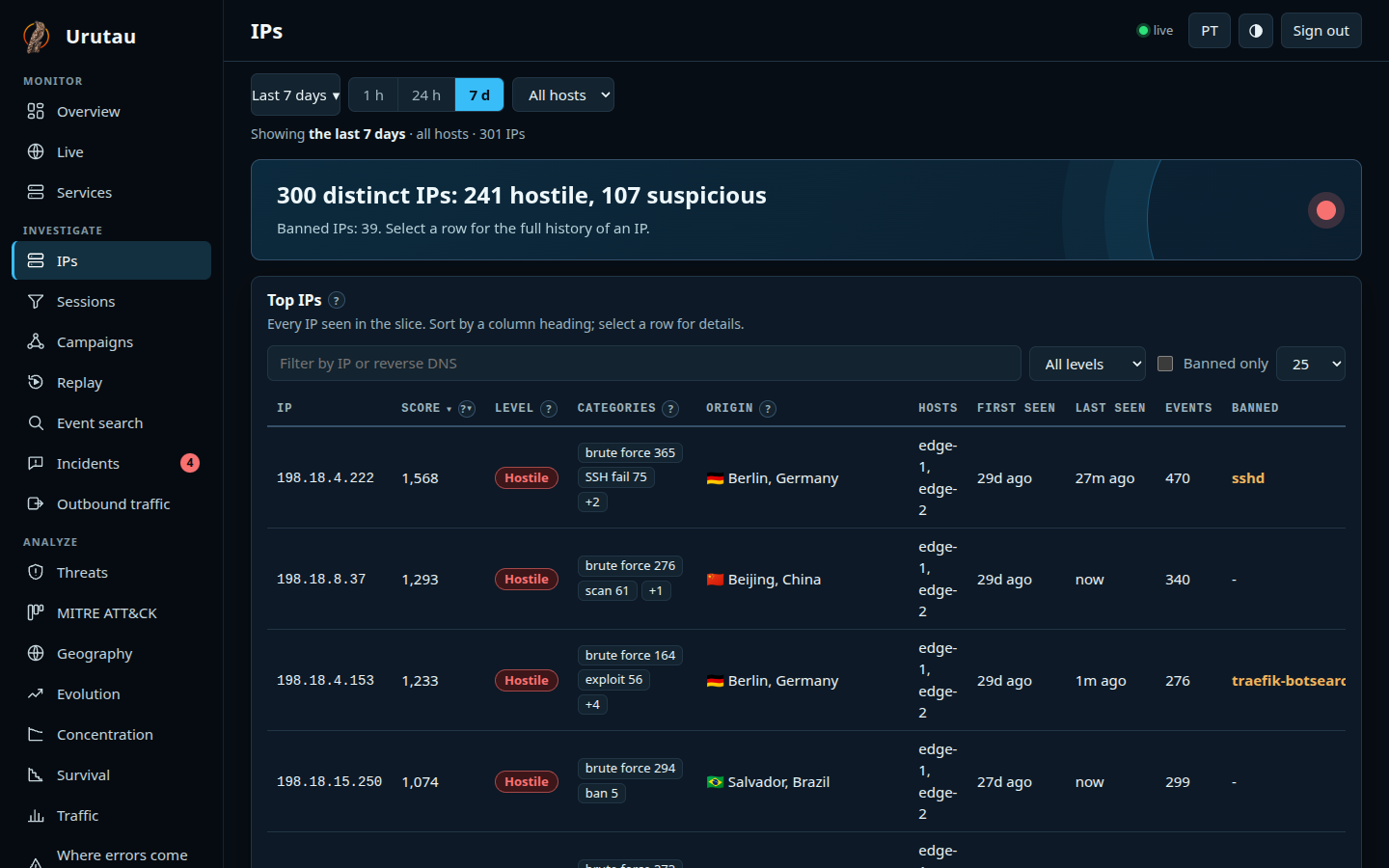
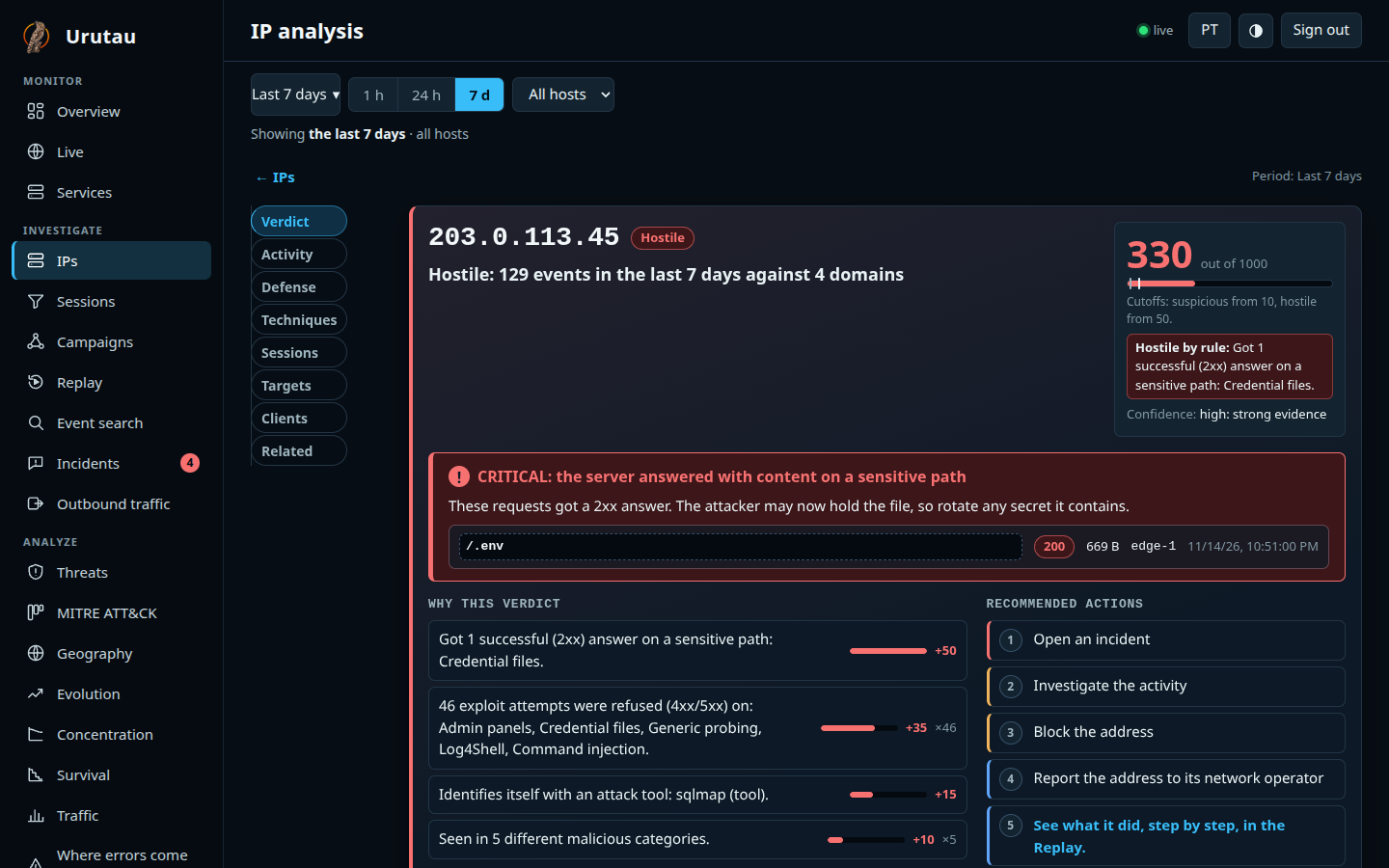
`.

Geography: the world by attacker country.

Geography: a country, by state and city.

Geography: a region, with its cities and top IPs.
**Evolution** (`#/evolution`): how attacks change over time.
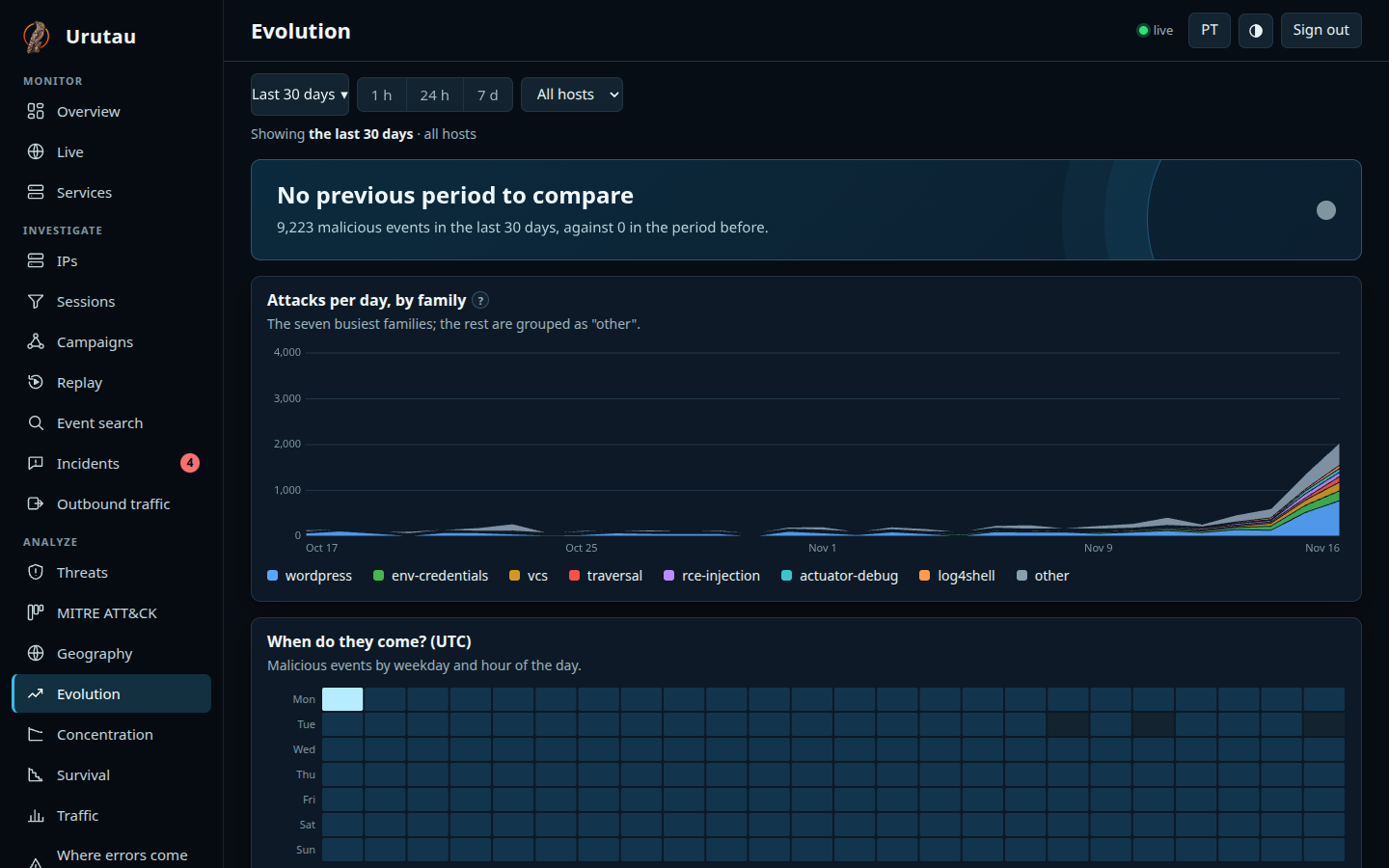
Evolution: how attacks change over time.
**Concentration** (`#/concentration`): how much of the hostility a few IPs or ASNs account for.

Concentration: how much of the hostility a few sources or networks account for.
**Survival** (`#/survival`): time to ban and Kaplan-Meier survival curves over attack episodes, with who blocked and how fast (the host fail2ban jails apart from the Urutau second firewall).

Survival: how long attackers keep coming back.
**Traffic** (`#/traffic`): privacy-friendly web analytics for legitimate traffic, built from the same Traefik log: unique visitors, pages, referrers, countries, browsers, operating systems, devices, response latency (p50 and p95), bytes sent and a world map of visitor countries, per domain. A unique visitor is a person with a real browser (a successful GET of a document by a browser User-Agent, one per IP per day, deduplicated globally); bots, tools and unknown clients are counted apart as "non-human clients". Visitors are counted by a hash with a daily salt; the IP of a legitimate visitor is never stored. See [SECURITY.md](../SECURITY.md).

Traffic: privacy-friendly web analytics.
**Where errors come from** (`#/errors`): errors split into the classes `app`, `proxy`, `blocked`, `attack`, `bot`, `client` and `unknown`, so a 5xx from your app is told apart from a broken link or a scanner; response classes, targets and hosts.
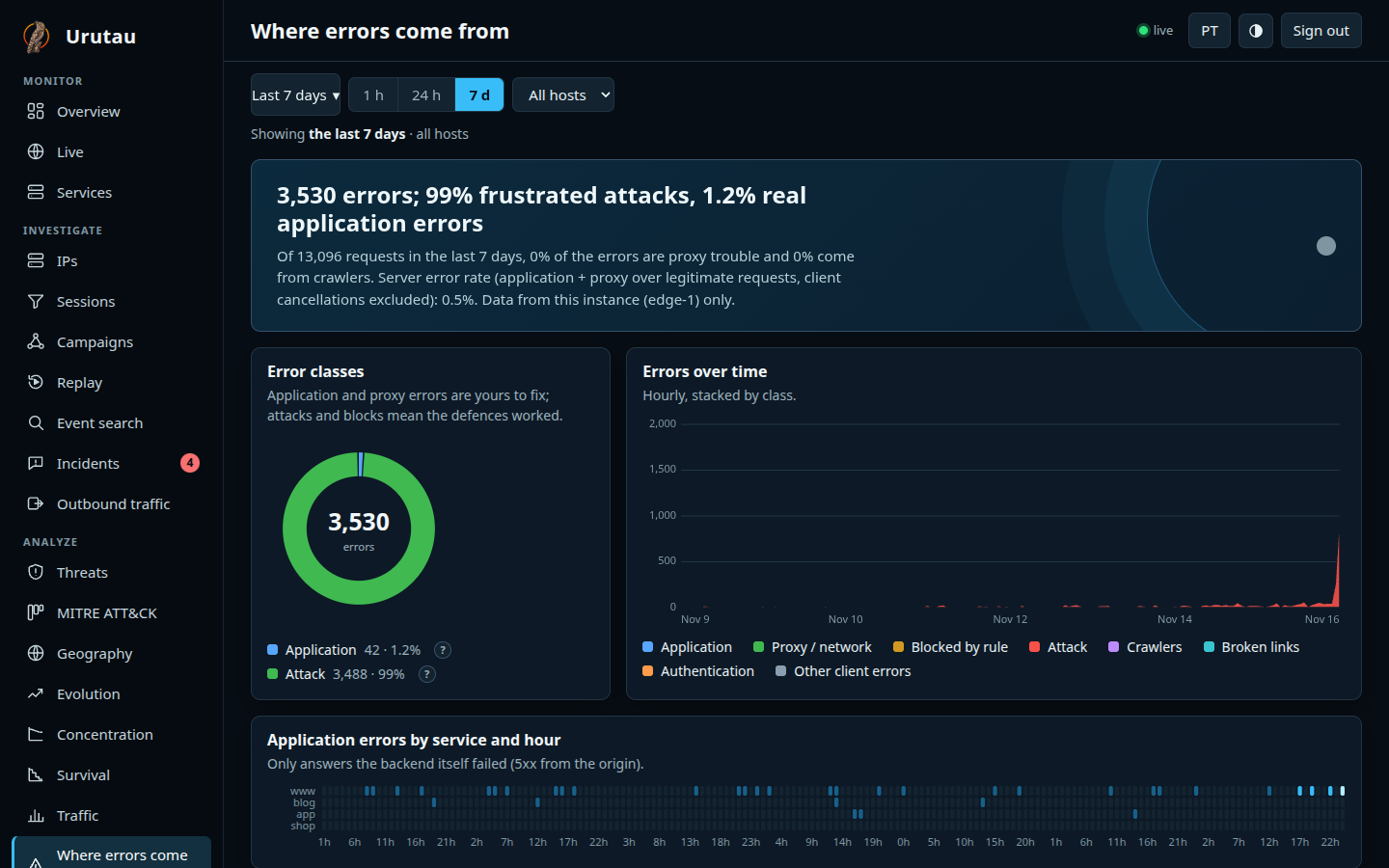
Errors: response classes, targets and hosts.
**Protocols and TLS** (`#/protocol`): HTTP versions, TLS versions and cipher suites in use, with the methods and the breakdown by class.

Protocols and TLS: HTTP and TLS versions by class.
### Operate
**Defense** (`#/defense`): coverage and leaks of bans and of the blocklist. An attacker counts as protected when it is listed or banned by any jail; the API also splits one-shot from repeat attackers (`one_shot`, `repeat_ips`). It also holds the **second firewall** section (`URUTAU_ENFORCE=off|observe|on`): the mode, recent decisions with their reason (for example `known-attacker`, `port-scan`, `neighbor-campaign`), coverage, and the operator releases. Urutau only decides and writes the decisions to a file; the host fail2ban (jail `urutau`) applies them, and in `observe` mode it shows what would be blocked. It never blocks trusted addresses, private ranges, CDN and public resolver ranges, probes, the server itself or crawlers verified by forward-confirmed reverse DNS (Googlebot, Bingbot, Applebot). An **Unban** button on recent decisions and on the address page asks the host to lift the block (through `unban.log` next to `--enforce-log`) and can keep the second firewall from banning the address again for 1 h, 24 h or 7 days. With `URUTAU_ENFORCE_SHARE` the nodes of the probes exchange decisions, each node applying its own exclusions.

Defense: coverage of the host fail2ban and the second firewall (observe mode).
**Sources and hosts** (`#/sources`): every probe with its state (connected, last line, lag, version, lines dropped by a full spool, spool size and command errors) and a form to create one (the token is shown once, with a ready compose snippet), edit its location and egress settings, or revoke it; for each probe, every log source with its state (`following`, `waiting`, `backfill`, `error`, and degraded when more than 20% of the last 1000 lines are unreadable), lines read, malformed lines and last event (file paths are not shown), and the **blocklist**: pick a minimum score (default 50), copy or download it. It only lists hostile, globally routable addresses (never `--ignore` or `--trusted` ranges, never an IP with a successful SSH login, never an address whose only evidence is a ban by the `urutau` or `recidive` jails); IPv6 appears as its /64, written `x:x:x:x::/64`.

Sources and hosts.
**Integrity** (`#/integrity`): health of the data: log sources, event registry and snapshot.

Integrity: health of the log sources and the registry.
### Reports
**Reports** (`#/reports`): a preview of the HTML report itself (`GET /api/v1/report?format=html`), always an A4 sheet scaled to the screen, with only Download and Print; language, period and server come from the header. The report has a cover, an executive summary in plain language, rule-based recommendations, threats, geography, errors and health, visitors, defense, second firewall and outbound traffic, printable on A4.

Reports: the exportable report.
## Themes and phones

The light theme on a desktop and the phone layout (a tab bar replaces the side rail).


Defense in the light theme and on a phone.


Outbound traffic in the light theme and on a phone.
On phones, plain data tables (concentration ranking, error routes, MITRE techniques, Defense, Integrity sources) turn into stacked cards with the column name as a label, and nothing scrolls sideways.
## Glossary and tooltips
A small **"?"** button sits next to metrics, categories and column titles. It is keyboard focusable and opens a short explanation (what the figure means) and a "what to do" line, in English or Portuguese. The text comes from one central glossary, so the same term reads the same on every page.
## Attribution
State and city boundaries on the Geography page are from [Natural Earth](https://www.naturalearthdata.com), public domain. IP geolocation data by [DB-IP](https://db-ip.com), licensed under [CC BY 4.0](https://creativecommons.org/licenses/by/4.0/). The credit also appears in the footer of the dashboard.
## HTTP routes
| Route | Auth | Purpose |
|---|---|---|
| `GET /api/health` | none | `{"status":"ok"}` |
| `GET /login`, `POST /login`, `POST /logout` | none | session |
| `GET /` and the static files | session | the dashboard |
| `GET /api/v1/summary` | session or bearer | everything the dashboard shows. Query: `range` (any named range) or `from` and `to`, `host` (`all`, a name) |
| `GET /api/v1/traffic` | session or bearer | web analytics of legitimate traffic. Query: `range`, `domain` (`all` or one domain), `host`. Returns visitors, pages, requests, bots, bytes, status classes, `p50_ms`, `p95_ms`, a timeline, top pages, referrers, countries, cities, browsers, operating systems, devices and bot names |
| `GET /api/v1/geo` | session or `URUTAU_TOKEN` | attacker geography. Without `cc`: `{"countries":[{"cc","events","ips","hostile","suspicious","cats"}]}` (up to 250). With `cc=XX` (and optionally `region`): `{"cc","events","ips","hostile","suspicious","cats","regions":[...],"cities":[{"name","region","lat","lon","events","ips"}],"top_ips":[...]}` (64 regions, 200 cities, 50 IPs). Query: `range`, `host`. Cached for 5 s |
| `GET /api/v1/live/recent` | session or `URUTAU_TOKEN` | `{"events":[...]}`: the latest malicious events of every probe, newest first, in the stream format. Query: `limit` (default 200, at most 500) |
| `GET /api/v1/events` | session or bearer | events of the registry, newest first. Query: `range` or `from`/`to`, `host`, `ip`, `cat`, `fam`, `q`, `order`, `limit`, `cursor` |
| `GET /api/v1/events/sessions` | session or bearer | sessions (bursts with a stage) of the period, optionally for one `ip` |
| `GET /api/v1/period` | session or bearer | the study of a period: sessions, campaigns, first-seen techniques, escalations, spikes, new vs returning, top targets, families, techniques, users and ASNs. Query: `range` or `from`/`to`, `host`, `gap` (seconds between sessions, 30 to 86400) |
| `GET /api/v1/period/events` | session or bearer | the events of a period in the stream format, for replay |
| `GET /api/v1/metrics` | session or bearer | stable metrics (see [architecture.md](architecture.md)). Query: `range` or `from`/`to`, `host` |
| `GET /api/v1/ip/{ip}/stix` | session or bearer | STIX 2.1 bundle of one IP |
| `GET /api/v1/techniques` | session or bearer | MITRE ATT&CK techniques seen in the period |
| `GET /api/v1/evolution`, `/concentration`, `/survival` | session or bearer | analytics of the period: change over time, concentration by IP and ASN, and time to ban with the Kaplan-Meier curve |
| `GET /api/v1/sessions/funnel` | session or bearer | sessions by stage (recon, probe, exploit, access, banned) |
| `GET /api/v1/campaigns`, `/api/v1/campaigns/{id}` | session or bearer | campaigns of the period, and one campaign with its IPs |
| `GET /api/v1/defense` | session or bearer | ban and blocklist coverage and leaks |
| `GET /api/v1/errors` | session or bearer | errors by class (`app`, `proxy`, `blocked`, `attack`, `bot`, `client`, `unknown`) |
| `GET /api/v1/integrity` | session or bearer | health of the data: sources, registry, snapshot |
| `GET /api/v1/report` | session or bearer | summary of a period (`format=html` returns the printable A4 report, with `lang`) (requests, attacks, hostile IPs, bans, visitors, non-human clients, page views, top IPs) |
| `GET /api/v1/services`, `/api/v1/services/{svc}` | session or bearer | per-service SLI, SLO, error budget, burn rate and Apdex |
| `GET /api/v1/protocols` | session or bearer | HTTP and TLS versions in use |
| `GET /api/v1/ips` | session or bearer | IP table. Query: `range`, `host`, `min_score`, `level`, `q`, `banned=1`, `sort` (`score`, `last`, `first`, `events`, `ip`), `order=asc`, `per` (1 to 200, default 50), `page` |
| `GET /api/v1/ip/{ip}` | session or bearer | summarized analysis of one IP: verdict with reasons, actions, families, techniques, network type, cadence, sessions and exposure; merged with the probes. Query: `range` or `from`/`to` (default 30d) |
| `GET /api/v1/events/stream` | session or bearer | Server-Sent Events, event `ev`, a ping every 20 s. With `visits=1` it also sends anonymous `visit` events (no address, at most 20 per second) |
| `GET /api/v1/blocklist.txt` | session or bearer | one IP per line. Query: `min_score` (default 50), `range` (default `7d`), `host`, `family` (`4`, `6`; default both; `4` suits `ipset hash:ip`), `download=1` |
| `GET /api/v1/blocklist.json` | session or bearer | `{"generated","min_score","count","ips":[{"ip","score","last","hosts"}]}`; the `ip` of an IPv6 entry is a `/64` prefix |
| `GET /api/v1/incidents` | session or bearer | incident tickets (no comments or history, with `comment_count`). Query: `status` (comma list), `severity`, `host`, `q`, `sort` (`updated`, `severity`, `last_seen`), `page`, `per_page` (max 200). Returns `{items,total,counts}` |
| `GET /api/v1/incidents/{id}` | session or bearer | full ticket with `comments` and `history` |
| `GET /api/v1/incidents/export.csv` | session or bearer | the filtered list as CSV |
| `POST /api/v1/incidents` | session or bearer | opens a manual ticket `{title,detail,severity,host,tags,author}` (body up to 64 KiB, unknown fields refused; cross-site refused) |
| `PATCH /api/v1/incidents/{id}` | session or bearer | partial update `{status,severity,assignee,tags,title,verdict,suppress,author}`; each change is a history entry. `suppress` only in `false_positive` or `benign`, and hides findings with the exact same key in `/api/v1/egress` (add `suppressed=1` to see them) |
| `POST /api/v1/incidents/{id}/comments` | session or bearer | adds a comment `{text,author}` |
| `GET /api/v1/egress` | session or bearer | outbound-traffic analysis: verdict, findings (with `samples`, `ticket_id`, `ticket_status`, `suppressed`), workloads, `by_country`, `suppressed_count`. Query: `range`, `host`, `suppressed=1` |
| `GET /api/v1/enforce` | session or bearer | second firewall: mode, recent decisions, coverage and operator releases (`allows`) |
| `POST /api/v1/enforce/unban` | session or bearer | asks the host to lift a block and, optionally, keeps the address from being banned again for 1 h, 24 h or 7 days (cross-site refused) |
| `DELETE /api/v1/enforce/allow` | session or bearer | ends an operator release |
| `GET /api/v1/probes`, `POST /api/v1/probes`, `PUT /api/v1/probes/{name}`, `DELETE /api/v1/probes/{name}` | session or bearer | probe registry behind the Sources page: list with state, lag and counters, create (`{"name"}` answers `{"token"}`, shown once), edit location and egress, revoke (keeps the data) |
| `POST /api/v1/probe/hello`, `POST /api/v1/probe/push`, `GET /api/v1/probe/commands` | probe token only | the probe protocol ([architecture.md](architecture.md#probes-and-the-hub)); every other route answers 401 or 403 to a probe token |
An invalid `range` or period answers 400, and `range` in the responses is an object `{name,from,to,step,clipped}` (`step` is the timeline granularity in seconds).
API clients send `Authorization: Bearer `. A probe token is accepted only by the three `/api/v1/probe/*` routes (with the `X-Urutau-Probe` header); every other route refuses it. The 1.x `/api/v1/peer/*` routes are gone (404).